Most managers sing the praises of understanding ROI without practicing what they preach. I myself don't calculate ROI nearly as often as I should, because it's often difficult to do and sometimes it's something that falls by the wayside in the midst of the noise and hustle of the workplace.
Return on Investment means a lot of things; it means one thing in the world of accounting, another in the world of financial investments, and it means another in the scope of project management. We're just managers of one sort or another here at Working Smarter, and we use ROI as a figure to illustrate the costs and benefits of our projects. We find that calculating ROI helps us avoid pitfall projects, helps get our co-workers to buy-in to project ideas, and helps us prioritize how we use our resources.
When I calculate ROI for a project or a new marketing initiative I find that it is extremely helpful for my co-workers, my boss, and the other teams within our organization who might be involved with the project in some way, shape, or form. ROI figures help them buy into the project and help them prioritize their projects accordingly - something with an ostensibly high return on investment will be prioritized ahead of things with uncertain or perceptibly low ROI.
ROI is a simple concept; it's the total dollar/time return your organization will receive in exchange for undertaking a project or initiative of some sort.
But how do you actually calculate it? How do you accurately calculate the Return on Investment of your projects? Well, I'll show you - first we need to understand the two dimensions of ROI:
- Reduced Costs- The first way a project produces returns is in the form of reduced costs. In this situation you calculate ROI using this formula:
ROI = Change in Operations Cost / Costs of Project
- Increased Revenues- The second way a project produces returns is in the form of increased revenues to the organization. If a company decides to invest a ton of effort into developing a new product, the ROI for that new product will be the additional revenue that the project generates less the costs taken to produce and promote that product. You calculate the formula like this:
ROI = Change in Revenue / Costs of Project
We know how to calculate the overall ROI figures now, but what we really need to do is determine how to calculate the individual parts for both formulas. There's a process for doing this, which I have defined below:
Although it looks complicated, it's actually not too bad once you learn how to use the right tools to do each step. People have written books on this stuff, so I'm not going to go into extensive detail, but I'll be able to give you enough to get you started with ROI.
This is a very, very familiar step for long-time Working Smarter readers - to accurately determine how much work is needed to complete a project, simply decompose the project's tasks into a series of very small, simple tasks using a mind map.
It's very difficult to accurately determine how much work is needed to complete a large task; therefore the most accurate way to schedule large tasks and projects is to break them down into groups of small tasks. Here's a relevant passage from the previous article:
Don't believe me? Let's [consider a project] that everyone can relate to: moving from one home to another. Consider these two groups of questions:
- How long will it take you to pack up all of your belongings, move them into your car, unload them into your new house, and unpack them?
- How long will it take you to do the following:
- Pack up all of the dishes, silverware and cookware in the kitchen?
- Pack up all of the delicate China and glassware?
- Pack up the five-piece dining set?
- Move the China cabinet into the car and unload it back at the new house?
Most people will find that it is substantially easier to produce more reasonable, reliable figures for the set of questions under item two than under item one. That's why we strongly recommend using mind maps to leverage this principle.
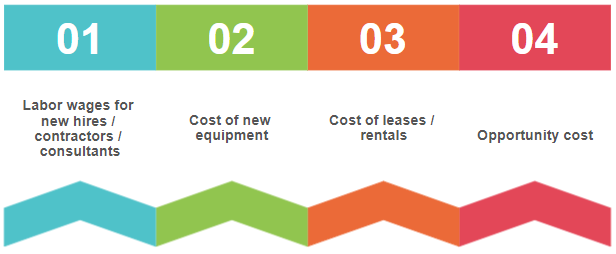
- Labor wages for new hires / contractors / consultants - Divide the work time between the new hires working on the project, determine the cost per / hour for each employee, and sum all of them up.
- Cost of new equipment - If you need to purchase any new equipment for your project, include all of the costs of purchasing that equipment (financing, installation, transportation, etc...) and add that as a cost.
- Cost of leases / rentals - If you need to lease equipment for your project, determine the duration of the lease based on your tasks and estimate the cost for that duration. Do this for every rental needed.
- Opportunity cost - Many project managers do different things when it comes to opportunity cost, because it's not a true "dollar cost" that shows up on a financial statement. Opportunity cost is the cost of picking this project over the next best alternative. It's really an issue that determines your priorities more so than your costs - a project with a high opportunity cost could still produce a positive ROI, but it might be that the next best alternative has a significantly higher ROI. Use this to determine how to use your in-house resources appropriately, such as your employees' labor and your company-owned equipment.
For projects that don't produce any new revenue you need to determine the extent of the costs eliminated by your project. You can do this by building a "before" workflow and an "after" workflow - study how your company's processes change before and after the projects are completed.
Once you've determine the change in costs, calculate the ROI:
ROI = Change in Revenue / Costs of Project
For projects that generate revenue, do the following:
Determine your target market / persona - determining your target market isn't easy, particularly if you're launching a new business. We outlined a simple thought process for determining a target market, but I suspect that many readers will not be satisfied with that explanation. The fact is that marketers will never have 100% of information needed to make a business decision - they have to cope with a lot of ambiguity, and our process is an acknowledgment of that.
The hard part: estimate the worst, average, and best cases for sales - estimating sales is never easy. Marketing isn't easy. But it has to be done. Write down your set of assumptions for new sales and new revenues, and based on those assumptions and your target market come up with three cases: the worst case, the average cast, and the best case for sales.
Present the sales cases to your team and come up with the "most reasonable" estimate - unless you're working by yourself, you should always confer with your team to determine if your assumptions are reasonable or not.
Determine the "likely revenue" based upon the "most reasonable" sales estimate - produce an actual dollar amount for your "new revenue" figure.
Once you have all of this information, you can make your calculation:
ROI = Revenue / Costs of Project
ROI calculations aren't always easy to do, but I've given you a guide here that should help many of you get started on the right foot.